Identifying Value-Creating Data Projects: A Comprehensive Guide
In today’s data-driven business landscape, organizations are inundated with data projects vying for resources and attention. The challenge lies not in executing more projects but in discerning which initiatives truly deliver strategic value. Misguided investments in low-impact data initiatives can drain resources and dilute focus from high-value opportunities. This comprehensive guide aims to equip data teams, business leaders, and analytics professionals with the frameworks, practical tools, and insights necessary to identify and prioritize data projects that generate measurable business impact.
—
The Importance of Prioritizing Data Projects with Real Business Value
Data projects are only as valuable as the insights and actions they enable. While many teams focus on technical excellence or innovation for its own sake, translating data initiatives into tangible business results is paramount. The core challenge is to evaluate potential projects against their ability to solve pressing problems, unlock revenue opportunities, or enhance operational efficiency.
Common Pitfalls in Data Project Selection
- Investing heavily in projects that don’t align with strategic goals
- Focusing on data collection rather than actionable insights
- Overengineering solutions that don’t fit business needs
- Underestimating the importance of data quality and governance
Addressing these pitfalls requires a structured approach, with clear criteria to assess potential projects’ value.
—
Frameworks and Methodologies for Identifying High-Impact Data Projects
Several strategic frameworks can help organizations filter and select data initiatives that align with their business objectives:
1. Value-Oriented Data Portfolio Management
This approach involves categorizing projects based on their potential business impact and alignment:
- High Impact, High Strategic Alignment: Prioritize and fast-track.
- High Impact, Low Alignment: Assess strategic fit carefully.
- Low Impact, High Alignment: Consider hybrid or incremental approaches.
- Low Impact, Low Alignment: Defer or decline.
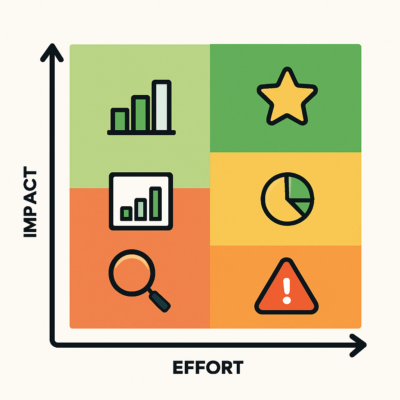
2. The Impact vs. Effort Matrix
Plot potential projects on a matrix to evaluate their expected business impact against required effort/cost. Focus on projects in the “quick wins” and “strategic bets” quadrants.
3. The Data Value Chain Evaluation
Assess projects across stages: data collection, processing, analysis, and action. Projects that optimize or impact actionable stages tend to be more valuable.
4. Use Case Prioritization Techniques
Employ tools like MoSCoW or RICE scoring models to quantify impact and effort, helping prioritize projects objectively.
—
Practical Steps to Identify and Prioritize Data Projects
Step 1: Align with Business Goals
Start by understanding core business priorities. Use stakeholder interviews, strategic documents, and KPI analysis.
Step 2: Define Success Metrics
Establish clear, measurable KPIs for what success looks like (e.g., revenue uplift, cost reduction, customer retention).
Step 3: Conduct Data Readiness Assessments
Evaluate current data quality, accessibility, and infrastructure maturity.
Step 4: Generate and Screen Ideas
Brainstorm potential projects. Screen ideas against strategic fit, data availability, and ROI.
Step 5: Perform Impact-Effort Analysis
Use impact-effort matrices to shortlist high-value, low-effort projects.
Step 6: Develop Business Cases
Build detailed justifications and expected outcomes for top projects.
Step 7: Build Prototypes or Pilot
Test high-priority projects on a smaller scale to validate assumptions.
Step 8: Measure and Iterate
Track progress against KPIs and adjust priorities based on learnings.
—
Case Studies and Real-World Applications
Case Study 1: Retail Forecasting Optimization
A leading retail chain used machine learning to improve demand forecasting. Initial projects focused on high-volume SKUs, leading to a 15% reduction in stock-outs and a 10% decrease in excess inventory.
Case Study 2: Customer Churn Prediction
An AI consulting firm developed predictive models for telecom clients, enabling targeted retention campaigns. Results included a 20% decrease in churn rate and measurable revenue gains.
Key Takeaways
- Focus on impactful, actionable use cases
- Validate ideas through pilot projects
- Use quantitative metrics to measure success
Tools and Resources for Identifying and Prioritizing Data Projects
- RICE Scoring Model: Quantify reach, impact, confidence, and effort.
- Impact/Effort Matrix Templates: Visual aids for quick prioritization.
- Data Readiness Assessment Checklists: Evaluate infrastructure and quality.
- Stakeholder Interview Guides: Capture strategic priorities.
- Data-Driven KPIs Dashboards: Measure ongoing success.
Final Takeaways and Next Steps
Identifying high-value data projects requires a disciplined, strategic approach rooted in clear business understanding and quantitative assessment. By leveraging frameworks like impact-effort analysis and data maturity evaluations, organizations can focus resources on initiatives that deliver maximum ROI.
Next Steps:
- Conduct a strategic data project audit.
- Engage stakeholders to align on key objectives.
- Use impact-effort tools to shortlist initiatives.
- Pilot high-potential projects and scale successful ones.