Building Secure, Scalable RAG Applications: Practical Steps to Enhance Enterprise Search with LLMs and Retrieval‑Augmented Generation
In today’s fast-evolving digital landscape, enterprises face the critical challenge of extracting meaningful insights from vast, complex data sets. Traditional search solutions often fall short, especially when incorporating the dynamic capabilities of Large Language Models (LLMs). Retrieval-Augmented Generation (RAG) offers a transformative approach, combining the strengths of LLMs with retrieval systems to deliver more relevant, accurate, and context-aware responses.
However, deploying RAG applications at scale within enterprise environments requires meticulous planning around security, scalability, and performance. This comprehensive guide explores practical steps and best practices for building robust, secure RAG applications that augment enterprise search capabilities while ensuring compliance and operational efficiency.
Understanding the RAG Paradigm and Its Business Value
Retrieval-Augmented Generation (RAG) integrates machine learning models with retrieval systems, allowing organizations to generate informed responses by fetching relevant data in real-time. Unlike standalone LLMs, which generate responses based solely on training data, RAG systems dynamically retrieve contextual information, significantly improving relevance and accuracy.
Business Implications
- Enhanced Search & Knowledge Management: RAG improves enterprise search, enabling users to access precise information swiftly.
- Better Customer Support: By delivering relevant, context-aware responses, RAG applications reduce resolution times.
- Data-Driven Decision Making: RAG helps in synthesizing data from diverse sources, supporting strategic insights.
- Operational Efficiency: Automates tedious research and data collation tasks, freeing up human resources.
Key Challenges
- Data Security & Privacy: Sensitive data handling requires stringent safeguards.
- Scalability & Performance: Growing data and user bases demand scalable infrastructure.
- Model Governance: Ensuring transparency, explainability, and compliance.
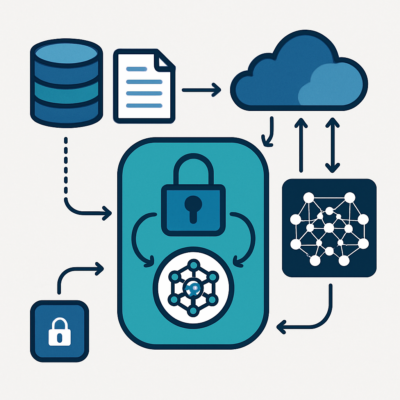
Core Components of a Secure, Scalable RAG Architecture
Designing an effective RAG application involves integrating several technical components seamlessly:
- Data Retrieval Layer: Efficient, secure data repositories and indexing mechanisms.
- Large Language Models: Fine-tuned LLMs optimized for enterprise-specific tasks.
- Orchestration & Middleware: Managing data flow, prompt engineering, and response synthesis.
- Security & Compliance Layer: Encryption, access controls, audit logs.
- Deployment Infrastructure: Cloud-native architecture, containerization, serverless options.
- Monitoring & MLOps: Continuous tracking of performance, drift detection, logging.
Step-by-Step Guide to Building a Secure and Scalable RAG System
1. Define Clear Use Cases & Data Policies
Start by clearly identifying the enterprise applications—be it knowledge base querying, customer service support, or internal analytics. Establish data governance policies emphasizing security, privacy, and compliance (GDPR, HIPAA, etc.).
2. Build a Robust Data Retrieval System
- Use scalable, secure vector databases like Pinecone, Weaviate, or FAISS for indexing.
- Ensure data ingestion pipelines incorporate validation, encryption, and access controls.
- Regularly update and audit indexes to prevent stale or compromised data.
3. Select and Fine-tune the LLM
- Choose enterprise-appropriate models (e.g., GPT-4, Llama 2) optimized for your domain.
- Fine-tune on your internal data, ensuring data privacy.
- Implement prompt engineering techniques for better context management.
4. Design a Secure Middleware for Data Orchestration
- Use API gateways and secure communication protocols.
- Manage prompt templates dynamically based on user roles and context.
- Apply content filtering and moderation for sensitive outputs.
5. Deploy in a Cloud Native Environment
- Opt for a serverless architecture to ensure scalability.
- Use container orchestration with Kubernetes for managing deployment lifecycle.
- Incorporate auto-scaling and load balancing features.
6. Implement Monitoring, Logging & MLOps Practices
- Use tools like Prometheus, Grafana, and OpenTelemetry for observability.
- Monitor data access, model performance, and response accuracy.
- Automate model retraining and drift detection.
7. Enforce Data Security & Compliance
- Integrate data encryption at all stages.
- Implement role-based access control (RBAC) and audit trails.
- Ensure compliance with relevant standards and GDPR.
Real-World Case Studies & Success Stories
Case Study 1: Healthcare Knowledge Platform
A leading healthcare provider built a RAG-powered search portal that securely retrieved patient data for clinicians. By deploying a cloud-native, secure architecture, they reduced search times by 40% while adhering to HIPAA standards.
Case Study 2: Enterprise Customer Support
A multinational retail chain implemented RAG to enhance their chatbot capabilities, improving resolution rates and customer satisfaction scores. Their scalable infrastructure handled peak loads seamlessly, yielding a 30% reduction in operational costs.
Conclusion
Building secure, scalable RAG applications unlocks immense potential for enterprises seeking to leverage AI for strategic advantage. By following best practices around architecture design, security, and deployment, organizations can harness the power of LLMs and retrieval systems responsibly and efficiently.