From PoC to Production in Weeks: Rapid ML Prototyping and Reusable Frameworks for Faster Time‑to‑Market
In today’s fast-paced digital landscape, organizations face mounting pressure to deliver innovative AI/ML solutions swiftly. The traditional, lengthy development cycles from proof of concept (PoC) to full-scale production can hinder competitive advantage, especially when market demands demand rapid iteration and deployment. This blog explores how leveraging rapid ML prototyping and reusable frameworks can transform your development process, enabling you to move from initial idea to fully operational models within weeks.
The Challenge: Bridging the Gap Between PoC and Production
Building and deploying machine learning models is often a complex, time-consuming endeavor. Teams encounter hurdles such as data integration issues, model tuning challenges, infrastructure limitations, and compliance concerns. The gap between PoC and production is not merely about scaling up; it requires a systematic approach to manage operationalization, retraining, and monitoring.
According to recent industry surveys, over 60% of organizations report delays of 3-6 months when transitioning from prototypes to production, leading to lost opportunities and inflated costs. For mid-market and enterprise firms, this delay can significantly impact time-to-market, revenue, and competitive positioning.
Pain points include:
- Fragmented workflows
- Lack of scalable reusable components
- Insufficient automation
- Data security and compliance hurdles
- Difficulty in maintaining models over time
The Solution: Rapid Prototyping and Reusable Frameworks
To overcome these challenges, organizations are adopting a combination of rapid ML prototyping techniques and reusable engineering frameworks. This approach emphasizes speed, flexibility, and standardization, empowering teams to iterate quickly while ensuring consistency and quality.
Key Components of a Rapid ML Framework
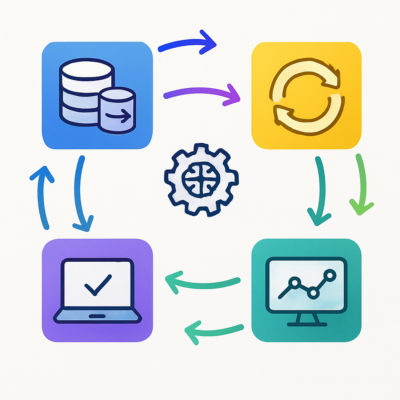
1. Modular Data Pipelines: Automate data ingestion, cleaning, feature engineering, and validation through reusable modules.
2. Shared Model Libraries: Develop and maintain a central repository of prebuilt models, templates, and algorithms.
3. DevOps-Driven MLOps: Implement CI/CD pipelines tailored for ML workloads, enabling seamless testing, deployment, and rollback.
4. Containerization and Cloud-Native Architecture: Leverage Docker, Kubernetes, and serverless platforms for scalable, portable deployment.
5. Model Monitoring & Governance: Integrate tools for drift detection, explainability, and compliance.
By standardizing these components, teams can rapidly prototype, test, and deploy models with minimal rework.
Implementing a Rapid ML Deployment Strategy
Step 1: Establish a Reusable Framework Foundation
Start by identifying common workflows, algorithms, and infrastructure needs within your organization. Develop or adopt frameworks like MG Systems & Software LLC’s own AccelerateML, which provides prebuilt modules for data processing, model training, and deployment.
Step 2: Promote Cross-Functional Collaboration
Ensure data scientists, engineers, and operations teams work cohesively to define reusable assets, versions, and best practices. Use collaborative tools and maintain clear documentation.
Step 3: Automate End-to-End Pipelines
Implement CI/CD pipelines with automated testing for model validation, security checks, and performance benchmarks. Utilize cloud-native tools for autoscaling and high availability.
Step 4: Focus on Model Monitoring & Lifecycle Management
Deploy models with integrated monitoring to detect drift and enable quick retraining. Use explainability tools to meet compliance requirements and improve stakeholder trust.
Step 5: Iterate and Optimize
Leverage feedback loops and anonymized data to refine your frameworks continually, reducing cycle times further.
Case Study: Accelerating Retail Forecasting Models
At MG Systems & Software LLC, a retail client needed to deploy a demand forecasting model in under four weeks—far before their original nine-month timeline. By adopting our RapidML framework, which included reusable data pipelines, containerized deployment, and automated monitoring, the team reduced development time by 70%. The result was a scalable, ready-for-market forecasting solution that provided real-time insights, enabling the client to optimize inventory and reduce waste.
Final Thoughts: Embrace Speed Without Sacrificing Quality
Deploying machine learning models from PoC to production in weeks is no longer a distant dream. By leveraging reusable frameworks, automation, and cloud-native architectures, mid-market and enterprise organizations can significantly reduce time-to-market, lower costs, and maintain competitive agility.